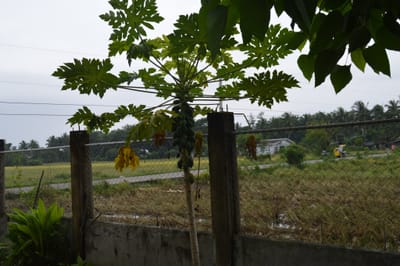
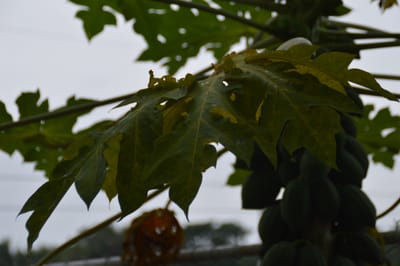
Common names: papaya
Scientific name: Carica papaya
Historical Information: succulent fruit of a large plant of the family Caricaceae. Though its origin is rather obscure, the papaya may represent the fusion of two or more species of Carica native to Mexico and Central America.
Scientific Information: The papaya plant is considered a tree, though its palmlike trunk, up to 8 metres (26 feet) tall, is not as woody as the designation generally implies. The plant is crowned by deeply lobed leaves, sometimes 60 cm (2 feet) across, borne on hollow petioles (leaf stalks) 60 cm long. Normally, the species is dioecious, male and female flowers being produced on separate plants, but hermaphroditic forms are known, and numerous irregularities in the distribution of the sexes are common. Male flowers are borne in clusters on stalks 90 cm long; the flowers are funnel-shaped, about 2.5 mm (0.1 inch) long, and whitish, with 10 stamens in the throat. The female flowers are considerably larger, on very short stalks, and often solitary in the leaf axils; they have five fleshy petals that are united toward the base and a large cylindrical or globose superior ovary that is crowned by five fan-shaped sessile stigmas.
Number of representatives: 1